

Insights and Trends
Apr. 23, 2026
Nutraceuticals (also known as functional foods) are food-derived ingredients that help regulate bodily functions, provide essential nutrition, and support disease prevention. This category includes well-known products such as vitamins, minerals, probiotics, fish oil, collagen, American ginseng, and reishi mushrooms.
The United States remains the world's largest consumer of functional foods, followed by China. In 2025, the global nutraceutical market was valued at approximately USD 500.6 billion and is projected to reach USD 657.8 billion by 2030, growing at a compound annual growth rate (CAGR) of 5.1%. As the fastest-growing market in recent years, China now accounts for 10–
12% of the global share.

(Global and China Nutraceutical Market Size Comparison 2020 - 2030E. Source: Fortune Business Insights, Mordor Intelligence)
Market Evolution in China
Over the past five years, China has witnessed a notable shift from traditional supplements (e.g., Vitamin C, Vitamin D, minerals) toward novel functional foods such as probiotics and sports nutrition. While vitamins and minerals still hold the largest market share, probiotics have grown rapidly from 10% to 14% in just two years. Sports nutrition has steadily risen to 15%, while other growing segments include Omega-3s, bone health, and eye care products.

(China Health Supplements Category Shfits, 2023 to 2025. Source: iMedia Research, LeadLeo Data)
Key Nutraceutical Trends (2026–2030)
According to multiple research institutes, the following trends will shape the industry:
Anti-Aging: A major accelerator in the functional food sector. By 2024, the anti-aging market had reached USD 7.3 billion and is projected to exceed USD 140.9 billion by 2034.
Gut Health: Microbiome studies are reshaping the probiotic market. Research shows that gut health is closely linked to immunity, metabolic health, the nervous system, and skin health. Probiotic applications are expanding from digestive health to whole-body wellness. In China, the market is projected to surpass RMB 116 billion (USD 16.57 billion) by 2026, with an annual growth rate of 15%.
Precision Nutrition: As DNA testing becomes more popular and affordable, personalized nutrition is emerging as a new sector. Consumers can take a DNA test to generate comprehensive, personalized molecular portraits, identifying exactly which nutrients their bodies need. This enables tailored supplement plans. In the U.S., Thorne HealthTech (NASDAQ:THRN) is a mature model, offering personalized, science-backed wellness plans. This market is expected to exceed RMB 8.8 billion in China by 2030.
Nutraceutical Packaging Transformation (2026 and Beyond)
If you've been following food safety news in the U.S., you may have noticed thousands of product recalls each year due to substandard packaging. Do you know how much that could cost you? And what about the brand reputation you've spent millions building? You can avoid these risks by consulting with Haozhong packaging experts.
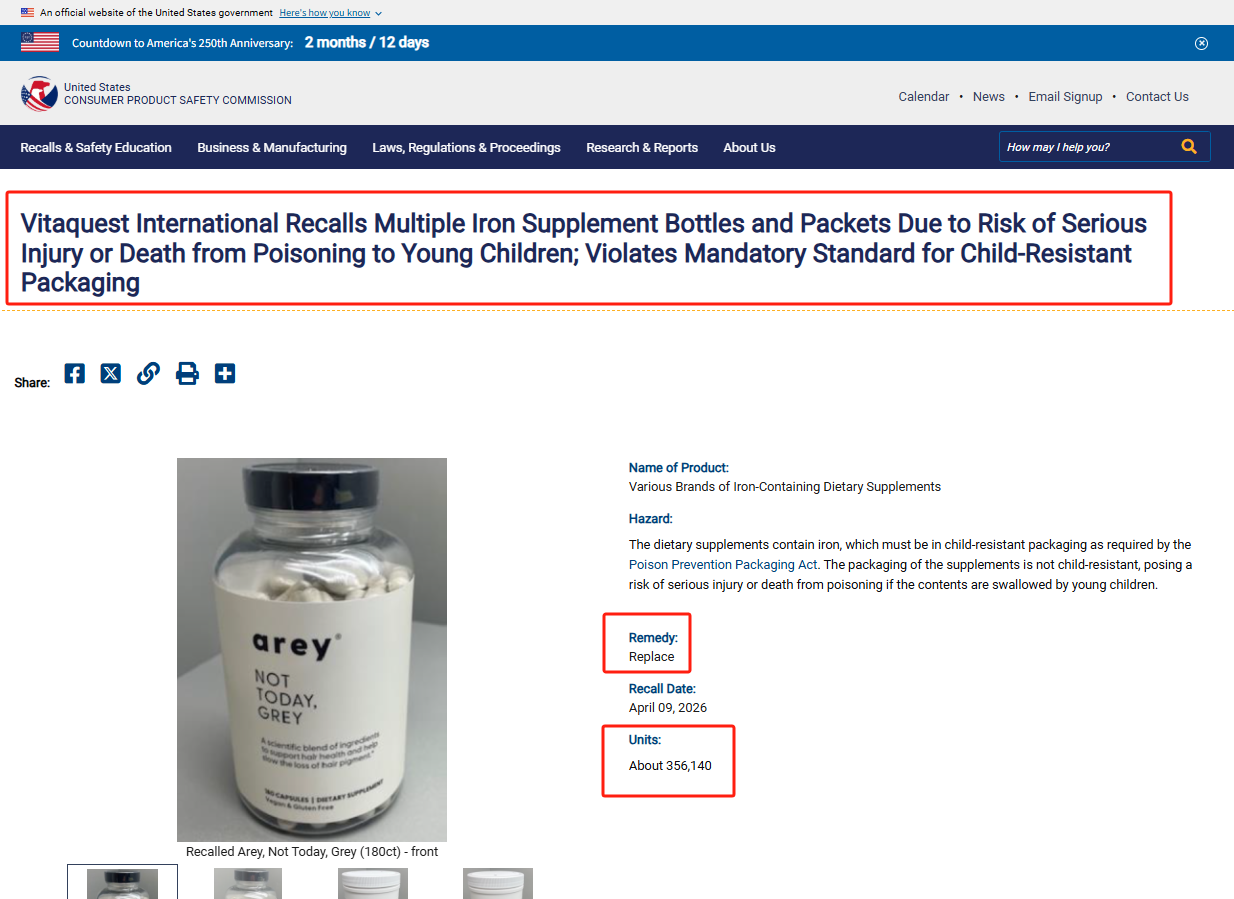
(Iron supplements recalls due to unsafty packaging. In the US, all iron supplement need to be packed within child-resistant bottles. Source: US CONSUMER PRODUCT SAFTY COMMISSION, government. )
Over the past decade, Haozhong has partnered with dozens of VDS brands launching products worldwide. That's why our experts know exactly which packaging suits your dietary supplement needs.
Policies and industry regulations change every year. Haozhong's in-house team continuously monitors updates in the nutraceutical sector—including shipping, tariffs, and customs—to ensure our clients launch their products on time.

(Nutraceutical packaging bottle production line)
Starting in 2026, nutraceutical packaging—covering dietary supplements, vitamins, and functional foods—is undergoing rapid transformation, driven by major shifts in the vitamins and dietary supplements (VDS) industry.
Beyond nutraceutical trends, three key forces are reshaping the packaging landscape:
Sustainability as a baseline requirement
Smart and digital integration for consumer engagement and traceability
Convenience-driven formats tailored to fast-paced, on-the-go lifestyles
According to Future Market Insights, the global nutraceutical packaging market is projected to grow from approximately USD 4.1 billion in 2026 to USD 6.5 billion by 2036 (CAGR ~4.7%) . This growth is driven by tightening regulations, the rise of e-commerce, increasing demand for personalization, and consumer expectations for packaging that is eco-friendly, protective, and interactive.
What Should Nutraceutical Brands Prioritize in 2026?
Policy & Regulatory Landscape
A major regulatory milestone is the European Union's Packaging and Packaging Waste Regulation (PPWR) , which takes effect in August 2026. While medical packaging is largely exempt, dietary supplements are fully subject to these rules.

Key requirements:
Design for recyclability
Mandatory use of post-consumer recycled (PCR) plastic
Eco-modulated Extended Producer Responsibility (EPR) fees tied to recyclability performance
The broader objective is clear: All packaging must be "recycle-ready" by 2030. For brands, this means rethinking material selection, supply chains, and packaging formats now—not later.
2. Market Demand Shifts
The Rise of Self-Care
The first half of the decade was shaped by pandemics, supply chain instability, and inflation. In response, consumers have made a sustained shift toward self-care, investing in products that support physical health, mental well-being, and emotional balance. This has accelerated hybrid nutraceutical products that combine multiple benefits (e.g., nutrition + cognitive support).

(Ember Glass Dropper Bottle, perfect for liquid and oil-based supplements. It has been widely applied in baby nutritions, such as probiotics for kid, baby vitamins. Also, fits for pet supplements.)
Implication for packaging:
Design must be intentional and user-centric—portable single-dose formats for office workers, easy-to-carry packs that fit into daily routines, and desk-friendly packaging that encourages consistent use. Convenience is no longer optional—it is a core value driver.
Demand for Clean-Label Products

The clean-label movement began in the 1970s–80s as a desire to avoid food additives and chemical-sounding names. It gained significant momentum in the 1990s as a demand for ingredient transparency, simplicity, and the removal of artificial additives. Later, the Clean Label Project was founded in California, becoming a driving force for global clean-label standards.
Consumers are increasingly conscious of ingredient safety and transparency. "Free-from" claims — such as no artificial flavors, no synthetic colors, and no preservatives — are highly influential in purchase decisions.
Implication for packaging:
Clear, transparent labeling builds trust. Ingredient-focused design helps differentiate products, and visual cues (minimalist design, earthy tones) reinforce natural positioning. Brands that communicate simplicity and honesty on-pack gain a competitive edge.
3. Sustainability: From Differentiator to Requirement

(Customized bottles for fish oil and Omega-3 supplements)
Sustainability is no longer a "nice-to-have" — it is a non-negotiable baseline, driven by three converging forces:
Consumer Expectations: An estimated 60–70% of U.S. consumers are willing to pay more for sustainable packaging.
Regulation: EU PPWR, "Recyclable by Design" mandates, expanding EPR schemes, and U.S. state-level regulations (e.g., California recycling rules).
Brand Positioning: Sustainability is now a key lever for differentiation and trust.
What This Means for Brands (and for Haozhong Packaging's Partners)
To stay competitive in 2026 and beyond, nutraceutical brands must:
Design packaging for circularity (recyclable, minimal, PCR-based)
Align with evolving regulations early to avoid costly redesigns
Prioritize convenience and usability in format innovation
Leverage packaging as a communication tool for clean-label and wellness positioning
Explore smart packaging technologies (e.g., QR codes, traceability features) to enhance engagement
Having a new nutraceutical product in mind? Reach out our packaing experts today and see how we can help you optimize product performance!
Related Article
Mar.25,2026
The global cannabis industry is maturing at breakneck speed. Legalization waves continue across key regions, with edibles, vapes, beverages, and wellness-focused products driving explosive growth. As a result, the cannabis packaging market is projected to reach approximately USD 4.29 billion in 2026, growing at a CAGR exceeding 14–22% through the
Mar.02,2026
Recent consumer trends show that beauty gift set purchases are shifting, with increased focus on Chinese New Year (CNY) instead of Christmas. Gifting remains central to the festival, with beauty products emerging as low-risk, popular choices. In January, Tmall saw double-digit growth in sales of perfumes (+30%), and makeup sets (+50%).
Jan.23,2026
Haozhong Global Watch: 2026 Key Trends, Growth Spurts and Opportunities in Cosmetic Packaging
In 2023, Grand View Research valued the global cosmetic packaging market at USD 32.67 billion, projecting a compound annual growth rate (CAGR) of 4.4% through 2030. By material type, plastic packaging dominated, accounting for 60.8% of total revenue share in 2023. This leading position is driven by plastic's significant price advantage.
Dec.24,2025
Haozhong's take: Fragrance Market Trends - Growth Amid Uncertainty
Despite economic uncertainty, the global fragrance market continues to thrive by aligning with deeper consumer needs—whether emotional well-being in China or sustainability in Western markets. Fragrance is no longer just about scent; it has become a powerful medium for self-expression, culture connection and responsible consumption.
Related Products

UV violet glass jars with child-resistant screw caps provide a high-performance packaging solution for sensitive materials requiring both preservation and safety. The biophotonic glass technology reduces light-induced degradation, maintaining product integrity over time, while the airtight construction minimizes exposure to air and moisture. The in
View More >>

HDPE Vitamin Dietary Supplements Nutraceuticals Capsule Tablet Bottle Food grade
Pressure-sensitive gaskets - aluminum foil gaskets can be used It can be processed by gilding, uv coating, heat transfer printing, etc Capacity: 60ml-150ml Suitable for use in multiple scenarios Win by quality and serve with dedication
View More >>

Lightproof vitamin dietary supplement nutraceutical pharmaceuticals tablet capsule packaging bottle
Built-in sealing system, effectively preventing moisture, oxidation and pollution Diverse specification options
View More >>

Glass Dropper Bottle 5ml 10ml 15ml 20ml 30ml 50ml 100ml
The glass dropper bottle features an exquisite appearance, supports customization, offers a custom logo, provides quality assurance, and offers considerate after-sales service
View More >>

Green Amber Glass Dropper Bottle 5ml 10ml 15ml 20ml 30ml 50ml 100ml
The specifications of glass dropper bottles are 5ml, 10ml, 15ml, 20ml, 30ml, 50ml and 100ml
View More >>
Transform Your Brand with Custom Packaging!
Elevate your product appeal and stand out in the global market. Contact us now to start your packaging journey!
Quick Links
Quick Links
Contact Us
Tel.: +86 133 4331 4977
whatsapp: 8619080114977
E-mail: haozhong@haozhongpackaging.com
Add.: 1st floor, Building 18, Area 3, Shangfeng Yunzhu, Xinhua District, Shijiazhuang City, Hebei Province
Get in Touch
Get in Touch
 عربي
عربي

 WhatsApp
 Wechat

 E-mail
 Back to top